Imago Season Inspirations
27 diciembre 2025
Imago Season is the narrative roleplaying game I'm developing (check it out on Steam if you haven't!) As you can guess, there are a ton of topics related to the game that I want to talk about. So for this first devlog, let's start with the basics. What am I drawing from to build Imago Season?
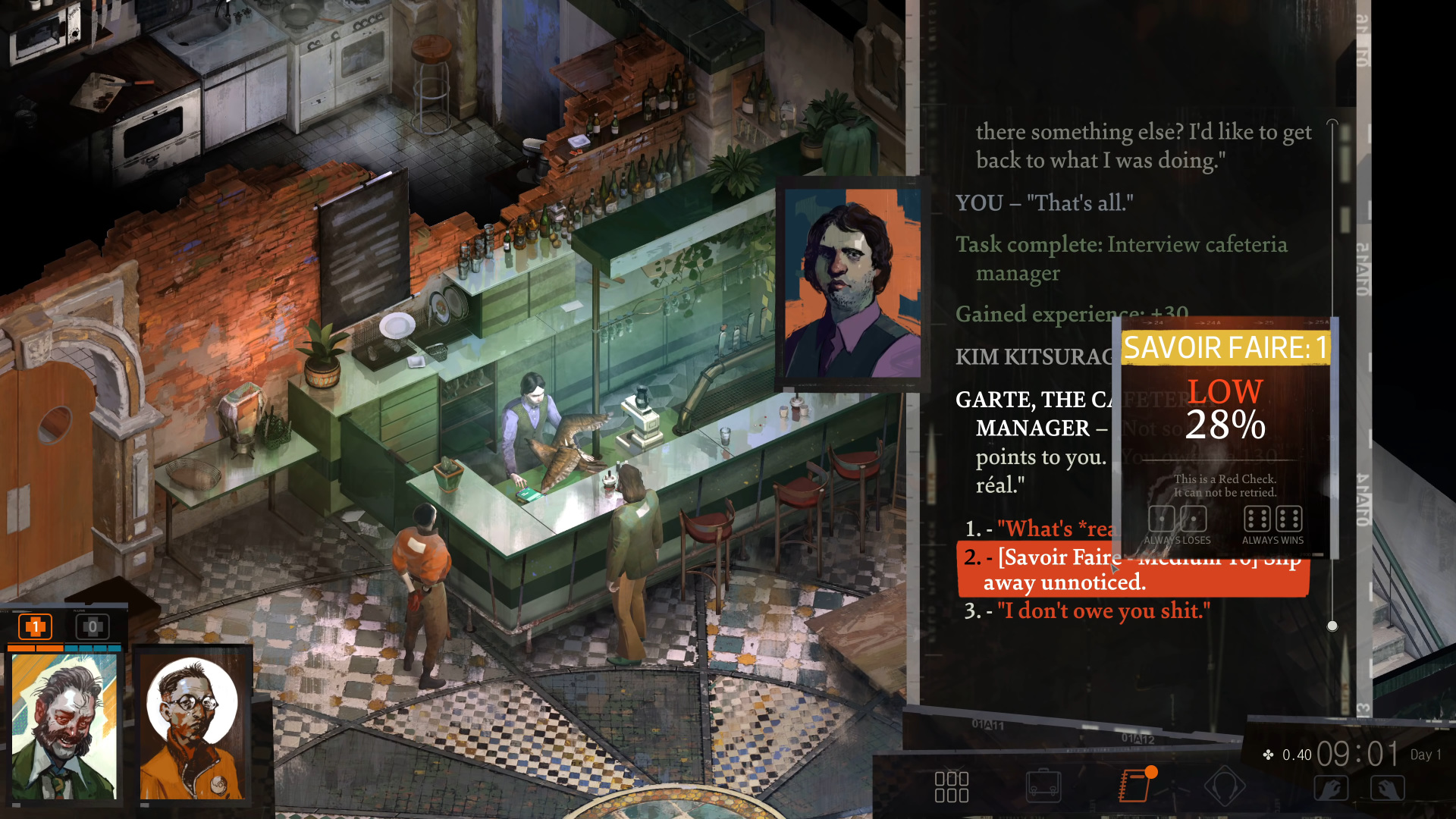
My main inspiration is, I believe, pretty obvious as soon as you take a look at Imago Season's interface. I'm trying to capture just a bit of the essence of Disco Elysium and the lineage of CRPGs it comes from. It is a tall task, but you have to aim high when working on something you want to be proud of! I am one of those people who fell in love with DE, amazed at the revelation that a commercial videogame could be like that. I played it in the summer of last year, when I was feeling burned out between my job at a big-ish videogame company and my hobby dev in the weekends, and so I decided to take a month off and actually play some games. I have been obsessed ever since.
From Disco I'm taking the conversation system and the way it manages dice rolls. I really like the way learning information in that game progressively unlocks more dialogue options and lets you retry (some) failed skill checks. I think it gives a strong mechanical basis to the detective work that you are doing narratively. What I have left out, however, is maybe Disco Elysium's more notable feature, which is the whole skills-are-voices-in-your-head thing. I think there are already plenty of DE successors attempting similar things, surely much better than I could, and as a narrative device I think it just doesn't fit the story I'm telling in Imago Season.
The other big inspiration, maybe even more important but not so obvious, is Fallout. Also last year I played through Dread Delusion, which is somewhat of a Morrowind-like and, as such, shares some DNA with the Bethesda-made, RPG-lite, first-person-explorathon that modern Fallout is. Playing Dread Delusion reminded me of the fun I had with the Fallouts in the 2010s and placed three thoughts in my head:
- A small indie team can make this??
- I love when every random NPC has their own story and gives flavour to the setting.
- I wonder if you can make one of these without the forty hours of mindless combat.
(Re)playing New Vegas at the the beginning of this year, I kept thinking of how much I love the world and the characters, but how little I care for the shooting in that game. There are some games with great first-person combat, but New Vegas and Dread Delusion are not it. Their strength lies in their settings, the factions and the choices you can make to affect them. I wondered if I could write a short game drawing on that strength, while forgoing combat completely. The idea was enticing as a solo dev, too, since indie dev is often an excercise in cutting the fat and avoiding feature creep. And so, the idea for a narrative-heavy roleplaying game with first-person exploration was born.

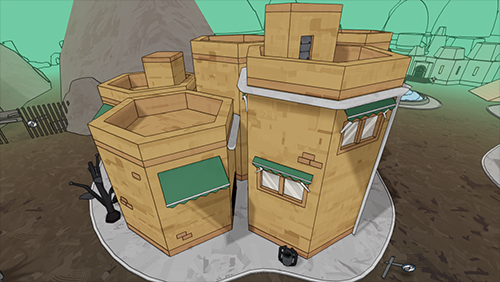
Narratively and stylistically, I am taking a lot from middle-century sci-fi. As a teenager I read the whole Foundation Cycle and it rewired my brain forever. I love pulp magazine covers and getting lost in the colorful worlds of their short stories. I have put much effort into reproducing the flat-shaded, outline-heavy style of my favourite comic books. For Imago Season's setting in particular, I have been very inspired by the human species in The Left Hand of Darkness and that novel's approach to exploring an alien society.
All of this, thrown into a blender with my local references and a good deal of costumbrismo. I believe, when making sci-fi, we have to try hard to keep away from Hollywood's and the AAA industry's predilection for either future-military-tech-vibes or dirty-star-wars-like styles. In Imago Season you explore an alien planet, but the houses look like they've been transplanted from any middle-sized Spanish city. The characters may have antennae sprouting from their heads, but they are worried about organising the festivities celebrating their patron saint.
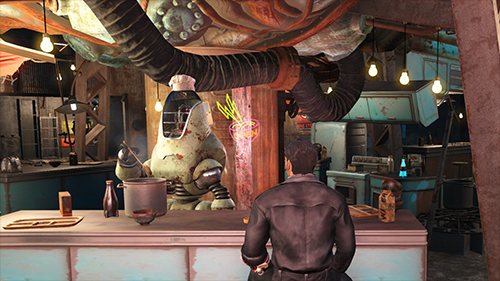
One of my favourite things to do in Fallout 4, in between all the base-building and raider-shooting, was to visit the restaurant at the center of Diamond City, that one with the robot chef. I'd sit on a stool, with Piper or Codsworth or whatever companion I had at the time by my side, and ask Takahashi for a bowl of noodles. Noodles, like most foods, is a healing item in Fallout, restoring a meagre amount of HP. Most items in these games aren't there to be useful, but to give texture to the world. You can carry cans and pencils and lunchboxes that fill your inventory and do nothing but turn the game world into a tactile experience. And, by buying some noodles at Diamond City, I could take a moment to roleplay my character resting at a familiar place. That is what I remember, ten years after the game came out. Because Bethesda games may not have the best-written stories or the most amazing visuals, but they sure as hell know how to make a place feel like home.
I hope that, when you are done with Imago Season, you will have the same feeling of familiarity with the City and its people.
You can wishlist Imago Season on Steam. It helps a lot with discoverability!